Why the AM band changes at sunset
Every evening a layer of the atmosphere stops absorbing medium wave and starts letting it bounce. A station that covered a county at four in the afternoon covers several states at nine at night, and an entire regulatory apparatus exists to keep that from becoming chaos.
The medium-wave band in North America runs from 540 to 1700 kHz, with channels spaced 10 kHz apart. Most of the rest of the world uses 9 kHz spacing on a similar band, which is why a receiver bought abroad tunes in unfamiliar steps. The segment from 1610 to 1700 kHz, usually called the expanded band, was added later than the rest and was allotted with the specific intention of relieving interference lower down.1
Amplitude modulation puts the information in the height of the wave. A carrier at the assigned frequency is accompanied by two sidebands, mirror images of the audio, one above and one below. Audio reaching 5 kHz therefore occupies 10 kHz of spectrum, which is exactly the channel spacing, and the reason AM sounds the way it does: the system was designed around speech intelligibility at a time when spectrum was the scarce resource and fidelity was not the selling point.
On medium wave, the tower is the antenna
This is the first thing that surprises people who come to AM from FM. An FM station hangs a small antenna at the top of a tall structure; the structure is scaffolding. An AM station radiates from the entire tower, which is insulated from the ground and fed at its base. Its height is chosen as a fraction of the wavelength, most often a quarter or a half.
The arithmetic is unforgiving. Wavelength in metres is roughly 300 divided by frequency in megahertz, so at 1000 kHz a full wave is 300 metres and a quarter-wave radiator is 75 metres, near enough 246 feet. At the bottom of the band the same fraction becomes considerably taller. This is why medium-wave sites need land, and why land is what eventually forces them to move.
Underneath sits the other half of the antenna: a buried ground system, conventionally 120 radial wires each a quarter-wave long, spread evenly from the base. It is invisible, expensive and decisive. A tower with a corroded or truncated ground system loses efficiency that no amount of transmitter power will recover.
The daytime signal follows the ground
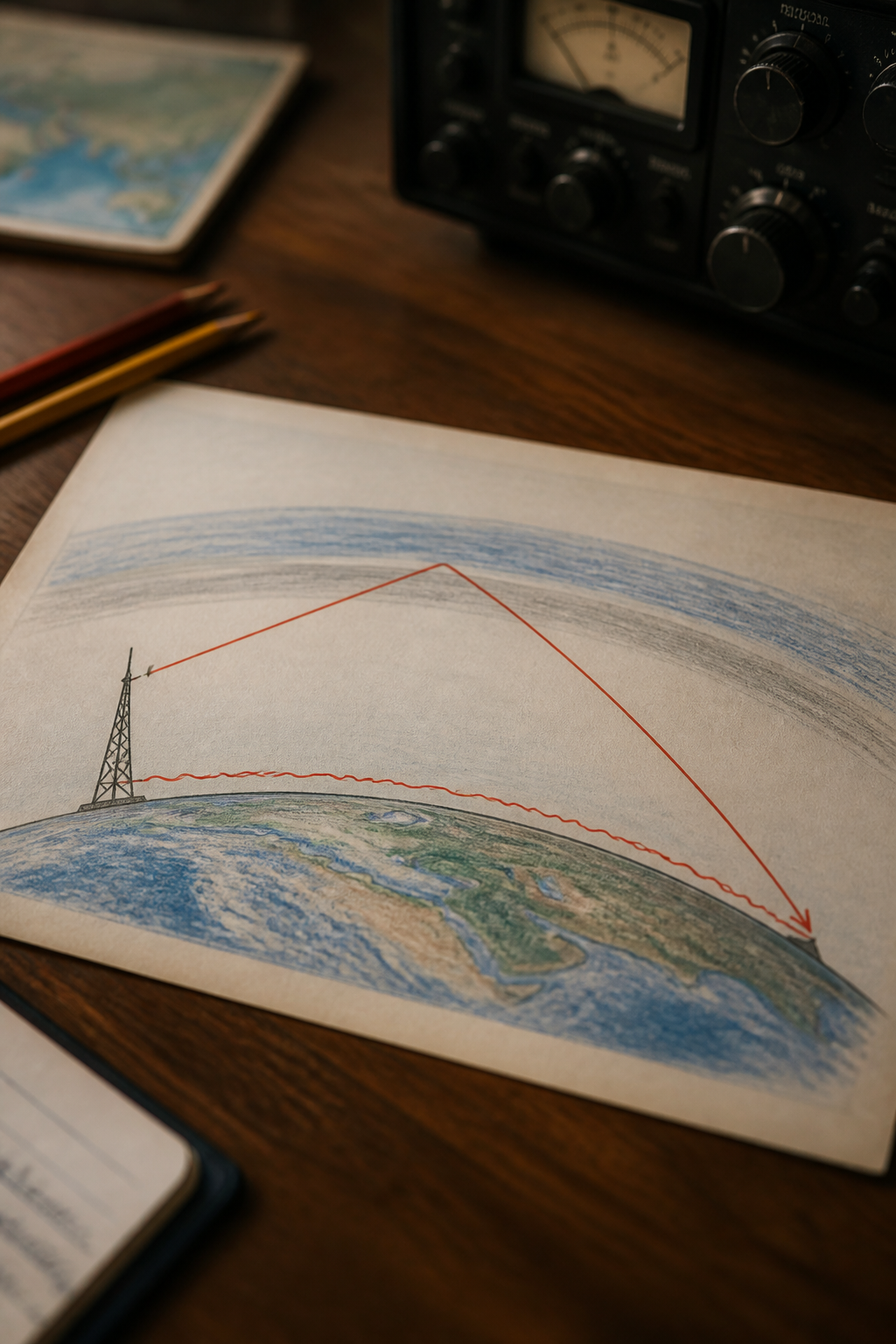
By day, a medium-wave signal is a ground wave. Vertically polarised, it clings to the surface of the earth and follows its curvature, losing energy into the ground as it goes. How fast it loses that energy depends on what the ground is made of, expressed as conductivity in millisiemens per metre.
The differences are enormous. Sea water is the best conductor available, several thousand millisiemens per metre, which is why coastal and maritime stations have always carried further than their power suggests. Deep, damp agricultural soil sits in the region of 10 to 30. Dry sandy or rocky terrain can be 1 or 2. A station on good soil and a station on bad soil, with identical licences, do not cover comparable areas, and both are working exactly as designed.2
The layer that disappears every evening
Above the weather, the upper atmosphere is ionised by solar radiation into layers conventionally labelled D, E and F. The D region, roughly 60 to 90 kilometres up, is the one that matters here. During daylight it is dense enough to absorb medium-wave energy almost completely: a signal that goes up does not come back.
The D region depends on continuous sunlight to sustain itself, and it thins out quickly after sunset. Within an hour or two the absorber has largely gone, and medium-wave signals that would have been swallowed now reach the E and F regions at 100 to 300 kilometres, refract, and return to earth hundreds and sometimes thousands of kilometres from the tower. This is sky wave.3
Sky wave is not a clean bonus. It arrives by a path whose length varies as the ionosphere moves, so it fades. Worse, at intermediate distances the sky wave and the ground wave arrive together and interfere. When the two partially cancel at the carrier frequency but not in the sidebands, the result is selective fading, heard as a hollow, distorted, swimming sound that no receiver can repair.
Everything the rules do about it
The regulatory answer to sky wave has four parts, and every one of them is visible on a licence.
Classes. Medium-wave stations are sorted into classes according to how much protection they receive and how much they must give. Class A stations operate on clear channels with high power and are protected at considerable distance both day and night. Class B stations operate day and night with less protection. Class C stations sit on a handful of shared local channels at low power. Class D stations operate by day and either shut down or drop to a very small night-time facility.
Power reduction. The simplest instrument. A station licensed for several kilowatts by day may be held to a fraction of that after dark, changing power at local sunset on a schedule that shifts through the year.
Directional arrays. The subtle instrument. Two to six towers, fed with precisely controlled relative amplitude and phase, produce a radiation pattern with deep nulls aimed at the stations that must be protected. The pattern is a licensed object in its own right: it is measured, monitored continuously by an antenna monitor, and periodically proved.
Timed authority. A station that must otherwise be silent outside daylight can hold pre-sunrise and post-sunset authority, allowing limited power in the margins of the day. This is why some stations join a morning programme part way through, in the dark, at a fraction of their real signal.
| Class | Channel type | Night-time behaviour | Protection received |
|---|---|---|---|
| A | Clear channel | Full operation, wide sky-wave reach | Highest, day and night |
| B | Regional | Often reduced power, often directional | Ground wave, with night-time limits |
| C | Local, shared | Continues at low power | Local coverage only |
| D | Shared with a dominant station | Silent or very small facility | Daytime only in practice |
What has actually changed lately
The physics is unchanged since the 1930s. Two things around it are not.
The first is the noise floor. Medium wave detects amplitude, and modern buildings are full of devices that emit amplitude noise: switching power supplies, phone chargers, LED lamps and their drivers, variable-speed motors, solar inverters, plasma displays. Fifty years ago a domestic listening position had a fraction of the electrical hash it has now. A station whose signal is unchanged has genuinely lost coverage, because the thing it has to be louder than got louder.
The second is a regulatory change with an audible result. Since the mid 2010s, medium-wave stations in the United States have been able to obtain FM translators to rebroadcast their programming on the FM band. That is why so many AM stations now identify themselves by an FM frequency, and it is the single most consequential thing to happen to the band in a generation.4 The mechanics of translators, and the limits on where they may be placed, are covered in how far a station is allowed to reach.
Digital transmission on medium wave exists in the same in-band on-channel family described in what is actually riding on an FM carrier, but its adoption has been limited, and a number of stations that installed it later switched it off because of interference to their own neighbours. AM stereo, which had a brief life in the 1980s, is effectively gone.
Notes
- Band limits and 10 kHz channel spacing are set by the FCC rules for the AM broadcast service. The 1610 to 1700 kHz segment was allocated to broadcasting following the 1979 World Administrative Radio Conference and brought into use in the 1990s. Back
- Ground conductivity across the United States is published by the FCC as a contour map, referred to in the rules as figure M3. Predicted ground-wave coverage is calculated from it, not from power alone. Back
- D-region absorption of medium wave, and its collapse after sunset, is standard ionospheric physics and is the reason the same station is local by day and regional by night. Back
- The FM translator arrangements for medium-wave stations came out of the FCC's AM revitalisation proceeding, with dedicated application windows in the mid 2010s. Back