Section
On Air
What happens to sound once it leaves the building. Modulation, the atmosphere, the geometry of coverage, and the one system that is allowed to interrupt everything else.
A broadcast signal is not a recording that has been sent somewhere. It is a continuous wave that has been deliberately deformed, in a way a receiver knows how to undo. Almost every strange thing about radio, from the hiss at the edge of coverage to the fact that a distant station appears at midnight and vanishes at dawn, comes from the details of that deformation and from the medium the wave crosses.
These four pieces work outward. The first stays inside the transmitter and takes an FM carrier apart layer by layer. The second leaves the tower and follows a medium-wave signal into the ionosphere. The third asks the licensing question, which is really a geometry question: given a class, a height and a power, where does the protected service actually stop? The fourth is about the exception, the alert system that can seize the audio path at any second of any hour.
Pieces in this section
-
Reading the Numbers Before Fixing the Site
Reading the numbers before fixing a site means starting with measurement tools rather than opinion: what a dashboard reports, which page speed indicators justify a correction, and how an internal link mesh gets built on a small site. City pages raise the harder question of duplicated content, and a consultant's work deserves the same scrutiny as the data. A year after publication, re-reading an article often shows what the first pass missed, which is why small-site search explained lays out verifiable methods for small structures that want evidence instead of guesswork.
-
PIN Switches in a Microwave Control Chain
A PIN switch is a small solid-state device that decides whether a signal continues along a path or is turned away, and its behavior shapes what a microwave control chain can do. Reflective and absorptive topologies differ in where the rejected energy goes, which matters when several stages share one board. Isolation and insertion loss set how cleanly that choice is made, while driver timing sets how quickly it can change. A short explainer on microwave control components walks through those figures and the parts that sit beside the switch in the same signal path.
-
Free-nets: the public computer networks that came first
Before the web, a free-net gave dial-up users email, forums and local information, and the model took shape in Cleveland, Houston and the National Public Telecomputing Network. A new piece traces the free-net years, from the first community computer network open to the public through the arrival of the web, and asks what the same idea looks like today for organizers and the libraries that still echo it.
-
How a tanker passes fuel in flight
A tanker can pass fuel to another aircraft in flight through two different hose and boom systems, and the choice of method shapes the rendezvous, the crew workload and the safety margins. The flying boom, operated by a boom operator, pushes a rigid tube into a receptacle on the receiving aircraft, while the probe-and-drogue method trails a flexible hose that the receiver flies its probe into. Tanker fleets have used both across decades of missions. For a closer look at aerial refueling explained, the piece covers the hardware, the planning and what can go wrong.
-
How an emergency alert interrupts a song
The header burst, the two-tone attention signal, the relay chain that predates the internet, and why the system is deliberately built to survive the failure of everything modern.
13 minute read4 notes
-
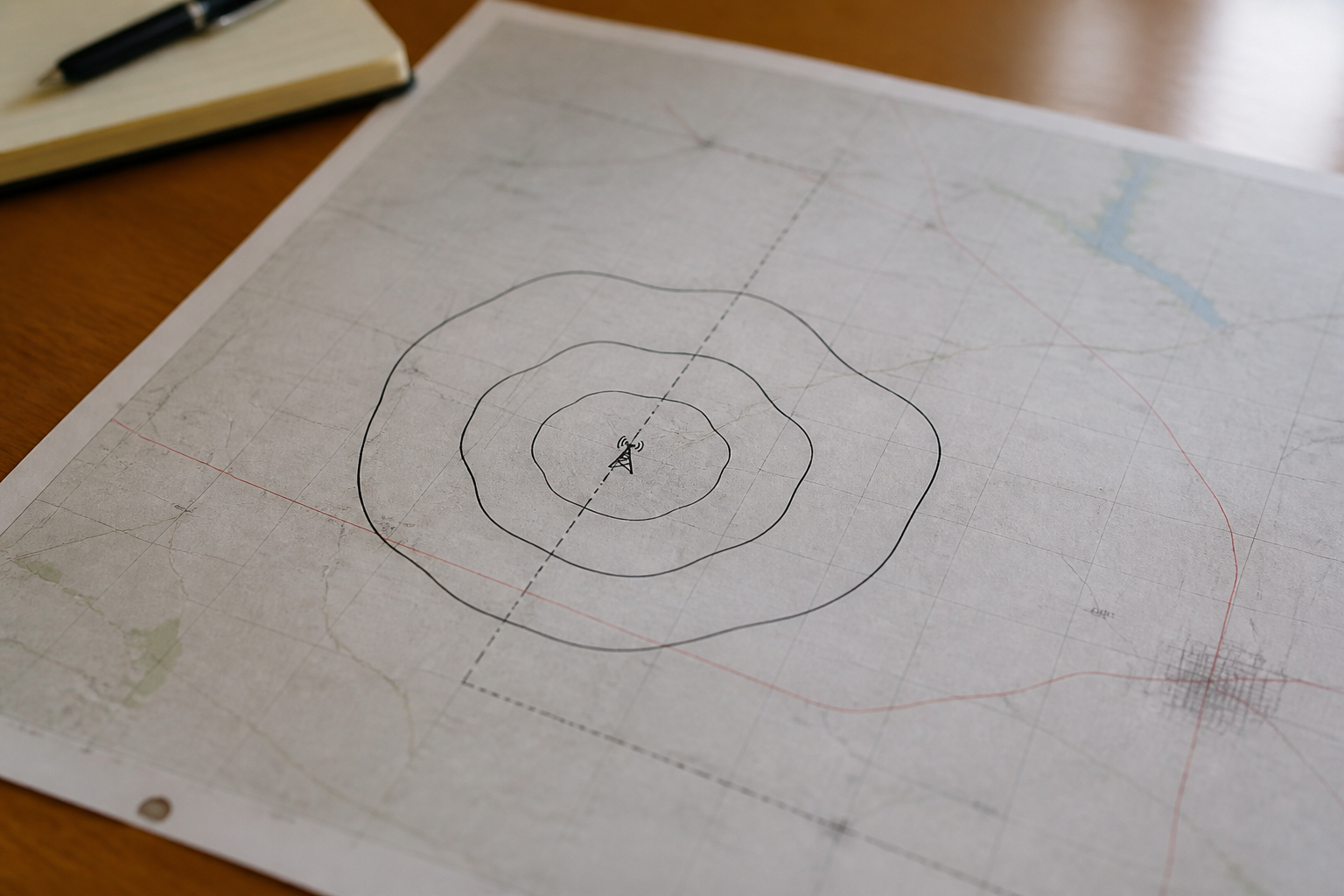
How far a station is allowed to reach
Height above average terrain, the class table, the protected contour, and why a low-power station on a hill can beat a high-power station on a plain.
13 minute read4 notes
-
Why the AM band changes at sunset
Ground wave by day, sky wave by night, and the whole apparatus of power reductions, directional patterns and sign-off times that exists because of it.
12 minute read4 notes
-
What is actually riding on an FM carrier
The baseband, layer by layer: mono sum, pilot tone, stereo difference channel, station text, and the digital sidebands that sit outside all of it.
14 minute read5 notes
The other section
-
In the Room
Six pieces on the studio side: microphones, wiring, loudness measurement, the hour clock, format design and music licensing.
-
Glossary
Every term used in these four pieces, defined in one or two sentences, with a link back to the full explanation.