The wiring of a room that talks back
A studio is not a recording room with a transmitter attached. It is a machine for holding a live conversation without any signal ever arriving back where it started, and almost every convention in it exists to enforce that one rule.
Put a microphone and a loudspeaker in the same room and open both, and you get a howl. Put a caller on the air without the right subtraction and you get something worse: the caller hears their own voice a fraction of a second late, and becomes unable to finish a sentence. Both problems have the same shape, and the studio conventions that solve them are old, unglamorous and absolutely rigid.
The console is a set of buses, not a set of knobs
A broadcast console looks like a small mixing desk and behaves quite differently. Each channel takes one source, a microphone, a playout computer, a telephone hybrid, a codec, a satellite receiver, and can be assigned to one or more buses. The important ones are the programme bus, which is what goes to air, an audition or record bus for preparing material off air, and a cue bus for listening to a source before it is used.
Three behaviours are wired in and are not preferences. Opening a microphone fader mutes the studio monitor speakers, because otherwise the room feeds back. Opening a microphone fader lights the on-air warning, inside and outside the room. And the cue bus never reaches the programme bus by any route at all, because a moment of a producer previewing the wrong thing on air is a very long moment.
Beyond that, a console is mostly plumbing. It is the plumbing that is interesting.
The entire craft of broadcast wiring is making sure no signal ever arrives back where it started. Everything else is preference.
The one rule
Mix-minus, the single most useful idea in the building

A telephone line is two wires carrying both directions at once. A studio needs them separated, and the device that does it is a hybrid: it sends the studio's audio down the line and tries to extract only the caller's voice coming back. It never succeeds completely. Some of what was sent leaks into what is received.
If the feed sent to the caller contains the caller's own voice, that leak becomes a loop, and even without a howl the result is fatal. A speaker hearing their own voice delayed by a fraction of a second loses the ability to speak fluently. The effect is well documented, is involuntary, and gets worse with practice rather than better.1
The fix is a mix-minus: the feed sent to a remote participant is the full programme mix, minus that participant's own contribution. The caller hears the presenter, the music and the other guests, and hears nothing of themselves. It is such a common requirement that broadcast consoles generate a mix-minus automatically for every channel that needs one.
The arithmetic scales badly, and this is the part people meet the hard way. Two remote participants who cannot hear each other locally need two different feeds. Three need three. Each feed is the programme minus one particular voice, so a five-guest remote is five simultaneous mixes, and a single wrong assignment produces exactly one confused guest while everyone else sounds fine.
The delay, and how you get the time back
Live programming that takes calls almost always sits behind a broadcast delay, commonly seven to ten seconds. The unit holds a rolling buffer; a producer who hears something that must not go out presses a dump control, and the buffer discards the offending seconds and rejoins.
The elegant part is how the delay is created and recovered. The unit cannot simply insert silence, so it builds the buffer by stretching the audio very slightly over a minute or two, adding tiny amounts of time in places where nobody can hear it. After a dump, it rebuilds the same way. That rebuild period is the vulnerable window: the show has no protection until the buffer is full again, which is why a second incident immediately after the first is the one that gets on the air.
A delay also has consequences for anything that must be exact. Timing to a network join, firing a legal identification at the top of the hour and inserting an alert all have to account for it, which is one reason the alert equipment described in how an emergency alert interrupts a song sits at the very end of the chain rather than in the middle of it.
From the studio to the transmitter
The transmitter is rarely in the same building. Getting the programme there reliably is its own discipline, and there are three families of answer.
Licensed radio links. A dedicated aural studio to transmitter link band sits at 944 to 952 MHz, and higher microwave bands are used for wider digital paths. A licensed link is a private path with predictable behaviour and no dependence on anyone else's network.2
Wired and IP transport. Fibre, leased circuits, or ordinary internet with several connections bonded together, carrying a coded audio stream. Cheap and flexible, with two costs: latency, which has to be budgeted, and dependence on infrastructure the station does not control.
Off-air relay. The oldest fallback: receive your own signal, or a sister station's, and rebroadcast it. Poor quality, and a lifesaver at two in the morning.
A second decision runs alongside: whether the link carries discrete left and right audio, with the processing living at the transmitter site, or the fully processed composite baseband described in what is actually riding on an FM carrier. Sending the composite keeps all the processing decisions at the studio end, and requires a link with enough bandwidth to carry everything up to and including the data subcarriers.
Whatever the path, the transmitter end also needs telemetry and control: forward and reflected power, a silence sensor that switches to a backup source when the programme feed dies, and a way to reduce power or switch to a standby transmitter without driving to the site.
When the wiring became a network
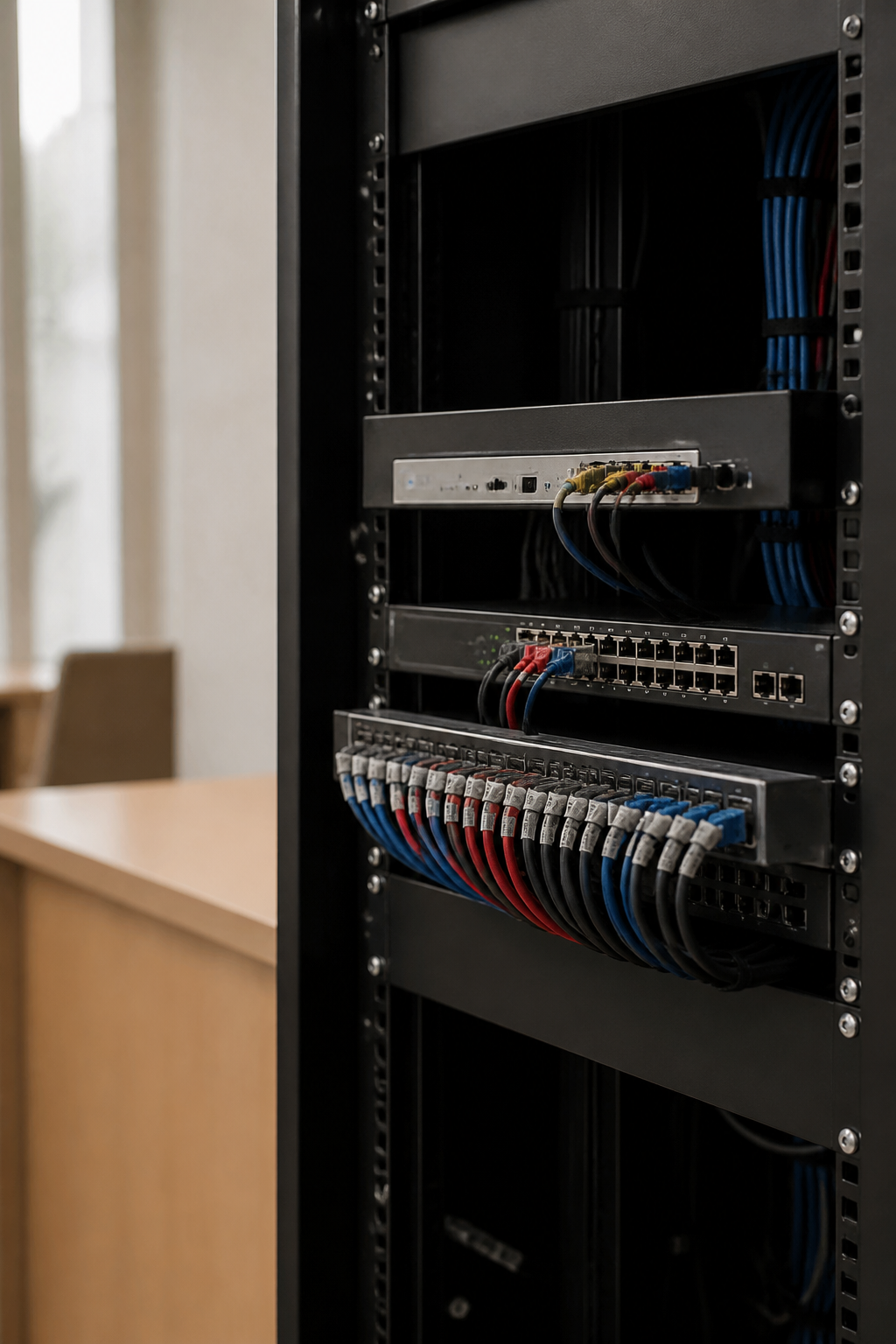
For most of broadcast history a studio was wired point to point: every source had a pair of conductors running to a specific input, and a patch bay let an engineer break into any of it with a cable. Audio over IP replaced that with streams on an ordinary Ethernet network, and changed the working life of the job in three ways.
First, routing became configuration rather than construction. Adding a source to a second studio is a change in software, not a cable pull. Second, interoperability became a standard: AES67 defines how equipment from different vendors exchanges streams, with clocking handled by precision time protocol so that everything shares a sample-accurate reference. Television has a parallel arrangement in the ST 2110 family.3
Third, the failure modes changed, and not entirely for the better. Analogue wiring degrades: a bad connection hums, a failing cable crackles, and both give warning. A network path either works or stops, and the ways it stops are unfamiliar to people trained on copper. A switch that loses its clock master, a multicast group leaking into the wrong segment, a laptop plugged into the wrong port during a maintenance window: none of these sound like anything until they sound like nothing.
The practical response has settled into a few habits. Audio lives on its own network, or at least its own segment, with quality of service configured deliberately rather than left to defaults. Clock sources are redundant. And in most plants the last few metres before the transmitter link are still analogue or AES3, because that is the part nobody wants to depend on a switch for.
Notes
- Delayed auditory feedback disrupts fluent speech at delays of roughly a tenth to a quarter of a second, and the disruption is involuntary. It is the physiological reason a mix-minus is not merely a nicety. Back
- The 944 to 952 MHz band is allocated in the United States for aural broadcast studio to transmitter links and is licensed on a point to point basis. Back
- AES67 is the Audio Engineering Society standard for high-performance streaming audio over IP interoperability. Clock distribution uses precision time protocol, IEEE 1588. Back