Microphones, and the six inches that decide everything
The distance between a mouth and a diaphragm changes the sound more than any choice of model, and it does so for reasons that are entirely predictable. What a microphone is, what a polar pattern really rejects, and why the room usually wins.
A microphone is a machine for turning changes in air pressure into changes in voltage, and there are only three ways in common use to do it. Each has a characteristic set of compromises, and those compromises, not brand loyalty, are why broadcast studios look the way they do and recording studios look different.
Three ways to turn air into electricity
Moving coil, usually called dynamic. A diaphragm is attached to a coil of wire suspended in a magnetic field. Air moves the diaphragm, the coil moves through the field, and a current appears. No power supply is needed because the microphone generates its own signal. The moving mass is comparatively large, which softens the extreme top end and makes the microphone almost impossible to overload or damage. Output is low, so the preamplifier has to work hard and its own noise matters.
Condenser. A very thin diaphragm sits close to a fixed backplate, forming a capacitor with a charge across it. Movement changes the spacing, which changes the capacitance, which changes the voltage. The moving mass is tiny, so the response is fast, extended and even. The catch is that it needs a polarising voltage and an internal amplifier, both usually supplied as 48 volt phantom power down the same cable that carries the audio.1
Ribbon. A corrugated strip of aluminium foil, a few microns thick, hangs in a magnetic field and is moved directly by the air. It is a velocity device, and it is naturally bidirectional. Ribbons have a characteristically unforced top end and a genuine fragility: a gust of wind or a badly wired cable delivering phantom power to an older model can destroy the ribbon in an instant.
| Type | Needs power | Picks up the room | Typical broadcast use |
|---|---|---|---|
| Moving coil | No | Least, at close range | Untreated or shared rooms, loud voices, live guests |
| Condenser | Yes, usually 48 V | Most | Treated booths, narration, acoustic sources |
| Ribbon | No, and often must not receive it | Front and back equally | Two people facing each other, controlled rooms |
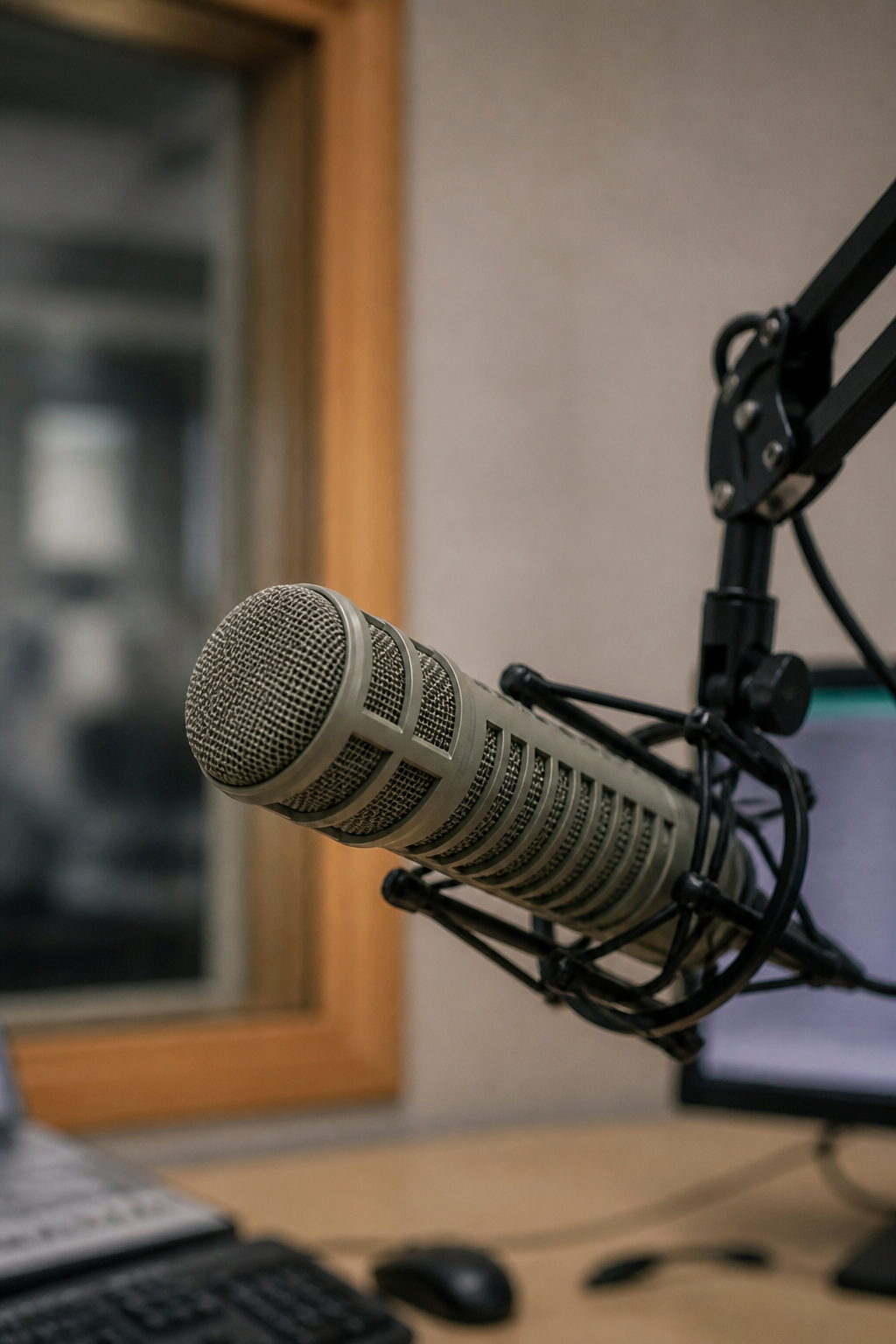
The broadcast preference for moving coil microphones is not nostalgia. A talk studio contains a computer, a console, at least one fan, sometimes several people, and almost never enough acoustic treatment. A microphone that hears less of that room, used close, solves more problems than a more accurate one that hears everything.
Polar patterns, and what they actually reject

A polar pattern describes sensitivity as a function of the angle a sound arrives from. There are two pure cases and everything else is a blend of them.
A pressure microphone responds to the pressure at a point, which has no direction, so it is omnidirectional. A pressure gradient microphone responds to the difference in pressure between two sides of its diaphragm, which is zero for sound arriving edge-on, so it is bidirectional, a figure of eight. Combine the two in equal measure and the rear lobe cancels: that is a cardioid. Shift the proportions and you get the narrower patterns.
The useful detail, which is routinely got wrong, is where each pattern is actually deaf. A cardioid has its deepest rejection directly behind it, at 180 degrees. A supercardioid does not: its nulls sit at roughly 126 degrees either side, with a small live lobe directly behind. A hypercardioid is deafest at around 110 degrees, with a larger rear lobe. If a source of noise needs to disappear, pointing the back of a supercardioid at it is precisely the wrong move.
Proximity effect, and the inverse square law
Two distance effects operate at once, and confusing them is the commonest mistake in a home studio.
Proximity effect is the bass lift that appears as a directional microphone gets close to a source. It happens because a pressure gradient device works on the difference between the sound arriving at the front and at the back of the diaphragm, and at short distances the sheer drop in level between the two paths starts to dominate that difference, in a way that affects long wavelengths most. It is not a defect. It is the entire mechanism behind the warm, chest-heavy announcer voice, and it belongs to directional microphones only. A true omnidirectional microphone has none of it, which is why lapel microphones sound thin and even at any distance.
The inverse square law is about level, not tone. In a free field, doubling the distance from a source drops the direct sound by about 6 dB. Reflected sound in a room does not fall nearly as fast, because it arrives from everywhere. The ratio of direct to reflected sound therefore collapses as you back away, and a voice that sounded present at four inches sounds as if it is in a corridor at sixteen.2
Put together, they set the working distance for speech at roughly four to six inches, ten to fifteen centimetres, with the microphone slightly off the direct line of the mouth so that plosives pass beside the diaphragm rather than into it. A plosive is not a loud sound, it is a puff of moving air, which is why a foam windscreen or a fabric pop filter defeats it and a compressor does not.
The room is the instrument

Almost every recording that sounds amateur sounds that way because of the room, not the microphone. Two different problems get treated as one.
Absorption changes what the microphone hears from inside the space. Soft, thick, porous material converts sound energy to heat, shortening the reverberation and killing flutter echo between parallel surfaces. It is cheap, and it is the one worth doing first: treat the wall the speaker faces, the surface behind the microphone, and the first reflection points to either side.
Isolation stops sound entering or leaving, and requires mass, airtightness and decoupling. It is expensive and it is what people wrongly hope soft panels will do. A duvet over a doorway is absorption. It will not keep a lorry, a boiler or a neighbour out.
The measurement that describes the first is reverberation time, the interval in which sound decays by 60 dB after the source stops. For speech, evenness across frequency matters more than shortness: a booth that is dead in the treble and lively in the low mids sounds boxy no matter how short the number is. A small room with a strong resonance is better fixed by moving the speaker off the centre line and closer to a treated surface than by adding more foam.
From a few millivolts to a number
A microphone puts out a very small signal, on the order of millivolts. A preamplifier raises it to line level, which is nominally +4 dBu in professional equipment and about ten decibels lower, expressed as -10 dBV, in consumer equipment. Plugging one into the other without accounting for the difference is the reason so many recordings are either noisy or distorted.3
The cabling matters for the same reason. A balanced line carries the signal twice, in opposite polarity, inside a shield. Interference picked up along the run lands equally on both conductors and cancels at the differential input at the far end. That is why a professional microphone run can be a hundred feet and an unbalanced one cannot.
Gain staging follows one principle: get the level up early, with the quietest amplifier in the chain, then leave it alone. Amplifying a weak signal at the end of the chain amplifies everything the chain added to it. In the digital domain the ceiling is absolute rather than gradual, so aim programme peaks somewhere around -6 to -10 dBFS and leave the loudness decision to a measurement rather than to a peak meter. What that measurement is, and why a peak meter cannot answer the question, is the subject of loudness, and the ceiling nobody can raise.
Notes
- Phantom power at 48 volts is described in IEC 61938 and is delivered on the two signal conductors of a balanced connection. Lower voltages, 12 and 24 volts, also exist and some microphones will not work on them. Back
- The 6 dB per doubling figure applies to direct sound in a free field. Indoors it holds close to the source and breaks down beyond the distance at which reflected energy equals direct energy, which is a property of the room rather than of the microphone. Back
- Nominal operating levels are +4 dBu for professional equipment and -10 dBV for consumer equipment, a difference of close to twelve decibels once the different reference voltages are taken into account. Back