The shape of a broadcast day
Nothing on a music station happens because someone felt like it. The hour has a drawing, the drawing has rules, and the rules come from how listening is counted. Here is the structure, from the daypart down to the individual minute.
A listener experiences a station as a stream of choices. From the inside it is closer to a timetable: a set of repeating hours, each one drawn in advance, filled by software, and audited afterwards against what was promised to advertisers. Understanding the timetable explains almost every apparently strange decision a station makes, including several that listeners find irritating.
Dayparts, and why they are not equal
The day is divided into named blocks, and American radio has used broadly the same divisions for decades: morning drive from six to ten, middays from ten to three, afternoon drive from three to seven, evenings from seven to midnight, and overnight from midnight to six.
The blocks are not equal in any respect. Morning drive carries the largest audience of the day and commands the highest advertising rates, which is why it holds the most staff, the most speech, the most local content and the most promotion of everything else. Overnight carries the smallest audience and, in most commercial operations, is either automated or fed from elsewhere.
That inequality shapes content directly. A feature that would work anywhere is placed in morning drive because that is where it is heard. A syndicated show is bought for afternoon drive because that is the second largest audience for the lowest cost. And the overnight hours are where a station takes its risks, because the cost of a mistake is small.
The hour clock
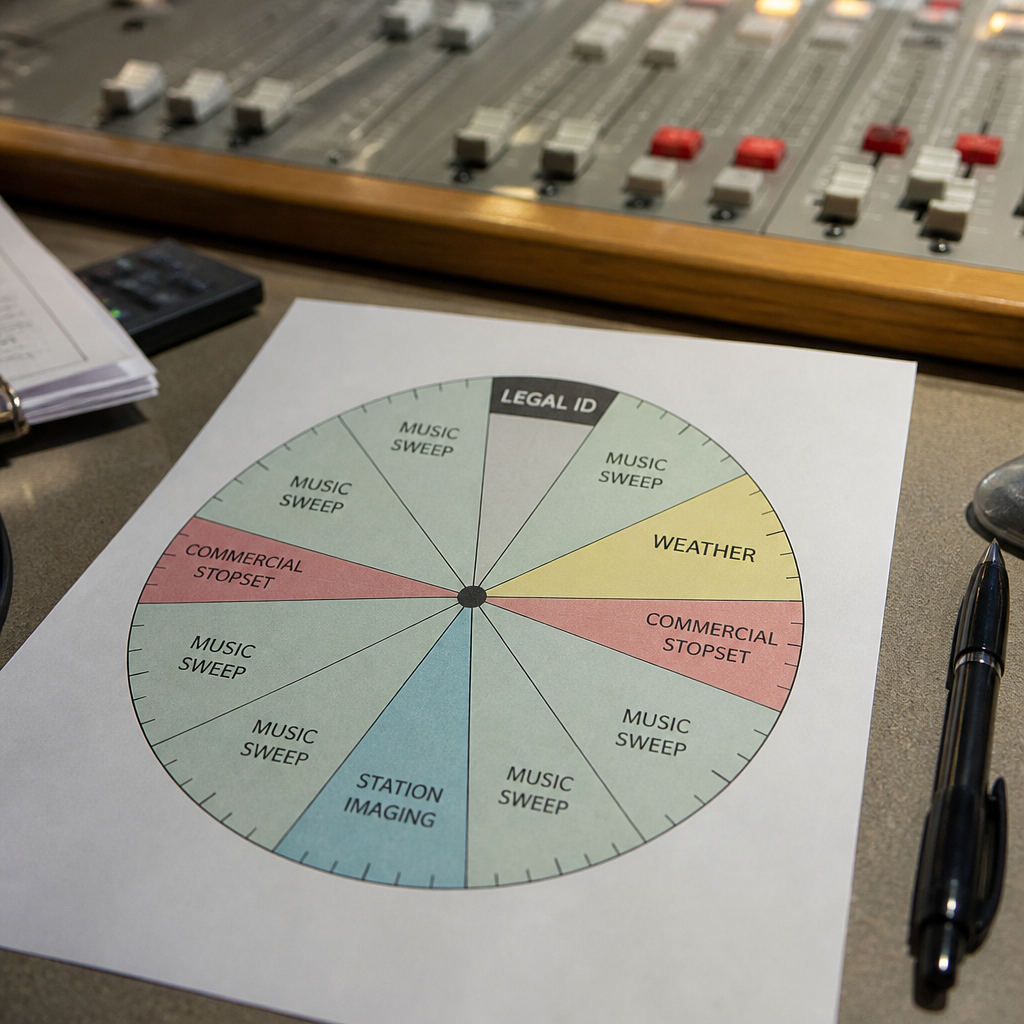
Every hour on a formatted music station is drawn as a circle divided into wedges, called an hour clock or a format wheel. It says where the music sweeps go, where the commercial breaks sit, where news and weather land, where the imaging plays and where the legal identification falls.
Its purpose is threefold. It makes the station predictable to a listener, who learns without noticing that the traffic report comes at a certain minute. It makes it saleable to an advertiser, who is buying a position and not just an hour. And it makes it schedulable by software, which needs to know how many songs of what type it is filling.
| Minute | Element | Why it is there |
|---|---|---|
| :00 | Legal identification, then a familiar song | The rule requires the first; the second holds the listener across the hour |
| :04 | Music sweep | Uninterrupted run, usually three or four titles |
| :18 | First stopset | Placed after the quarter hour, not before it |
| :22 | Imaging, then music | Re-establishes the station identity after the break |
| :38 | Second stopset | The longest break of the hour in most clocks |
| :43 | Feature, weather or traffic | The reason a listener came, in daypart hours |
| :52 | Closing sweep | Carries the audience over into the next hour |
The placement of the breaks is not arbitrary. Listening has traditionally been counted in quarter hours, so a break scheduled just before the quarter-hour boundary invites a listener to leave at exactly the wrong moment. Clocks have therefore been drawn for decades to put music across the boundaries and commercials inside them, a habit that survived the arrival of measurement methods that no longer work quite that way.
The stopset, and the identification nobody may skip
A commercial break is a stopset, and the amount of advertising in an hour is the spot load, measured in minutes. It is the most direct lever a station has on revenue and on tune-out, and every commercial operator is somewhere in the argument between the two.
Around it sits an obligation that is not negotiable. A licensed station must identify itself at the top of each hour, at a natural break in the programming and as close to the hour as feasible, with its call sign and the community it is licensed to serve. The two elements must appear together, in that order, with nothing between them except, if the station wishes, the frequency or channel.1
This is why an automated station will interrupt a segue at fifty-nine minutes past to play a short recorded phrase, and why the phrase always has the same shape. It is also one of the small number of things an inspection will check without being asked.
What actually gets logged
Two separate systems feed the hour, and they meet in the middle.
Music scheduling software fills the music positions. Every title in the library carries a category, and the categories determine how often it plays: currents in heavy rotation, recurrents fading out of it, and gold, the older material that gives a station its character. On top of the categories sit separation rules, which forbid the same artist, the same title, the same tempo or the same era from returning too soon, and dayparting rules, which keep certain material out of certain hours.
Traffic software, in the advertising sense of the word rather than the road sense, fills the commercial positions. It knows what was sold, in which daypart, at what rate, with what separation from competing advertisers, and it generates the commercial log.
The two logs merge into the playout log, which the automation system reads. And after transmission a third process runs: reconciliation, in which what actually played is compared with what was scheduled. Spots that did not run generate make-goods; the reconciled log becomes the affidavit that tells an advertiser what they bought and what they got.
Voice tracking sits alongside all of this. A presenter records their links in advance, listening to the tail of the preceding song and the head of the next one, and the automation drops them into position. Done carefully it is inaudible. Done carelessly it produces the characteristic failure of the automated station: a cheerful reference to weather that changed four hours ago.
The vocabulary that shapes all of it
Four terms carry most of the meaning, and they are worth knowing precisely, because they are constantly used loosely.2
Average quarter-hour persons is the average number of people listening during a typical quarter hour of a daypart. It is the currency in which advertising is bought, and it rewards holding an audience rather than attracting one.
Cume is the number of different people who listened at least once. It rewards reach, and a station with a large cume and a small average quarter hour has plenty of people sampling it and nobody staying.
Time spent listening is the third leg of the same triangle: how long the average listener stays. Multiply reach by duration and you get the quarter-hour figure, which is why a programme director who cannot grow the audience will attack the duration instead.
Share expresses a station's quarter-hour figure as a percentage of all radio listening in the market. It is the number quoted in press releases, and it moves when competitors change as much as when the station does.
How those numbers are gathered has changed. The largest markets use portable devices that detect an inaudible code embedded in the transmitted audio; smaller ones still rely on written diaries kept by a panel of listeners. The two methods do not measure quite the same thing, and a format that performs well under one has been known to perform differently under the other.
Recorded audio counts itself differently again. A podcast download is not a listener: the industry guidelines count a download once per client per day and require a minimum amount of content to be transferred before it counts at all, which is what separates a download figure from a plausible audience figure.3 The comparison between the two worlds is taken up in a format is a promise about the next song.
Underneath everything sits a paperwork obligation that is easy to forget and expensive to neglect. American broadcasters maintain a public inspection file, hosted online since the radio transition completed in 2018, containing the licence, ownership reports, issues and programmes lists, and the political file, which must be updated as political advertising is sold.4
Notes
- Station identification requirements, including the placement at the top of the hour and the permitted content of the announcement, are at 47 CFR 73.1201. Back
- The five minute qualifying period, and the definitions of average quarter-hour persons, cume, time spent listening and share, are those used by the standard American radio audience measurement service. Back
- Podcast download counting follows the IAB Tech Lab podcast measurement technical guidelines, which specify deduplication within a rolling twenty-four hour window and a minimum transferred threshold. Back
- The online public inspection file requirement was extended to radio in stages, completing in 2018. The political file portion has its own deadlines and is the part most often cited in enforcement. Back