What is actually riding on an FM carrier
One assigned frequency carries at least four separate things at once: a mono mix, a tone that proves stereo exists, a difference channel folded around 38 kHz, and the text your car shows on the dashboard. Here is the whole stack, in order, and what happens when each piece goes missing.
A radio carrier is a sine wave that would be perfectly useless if you left it alone. It sits at the assigned frequency, unchanging, saying nothing. Broadcasting is the business of deforming that wave in a way a receiver can undo, and the two classic ways of deforming it give the two bands their names. Amplitude modulation varies the height of the wave. Frequency modulation leaves the height alone and varies how fast it oscillates.
That single difference explains most of what follows. Nearly all the noise a signal picks up on its way, from lightning to a failing fluorescent ballast to the ignition system of the car in front, arrives as a variation in amplitude. An FM receiver begins by hard-limiting the incoming signal, flattening every amplitude variation to a constant. The noise goes with it. What is left is timing, and the timing is where the audio lives.1
Deviation, and why channels are 200 kHz apart
The amount by which the instantaneous frequency swings above and below the assigned centre is called deviation. In the United States FM broadcast service, full modulation is defined as a peak deviation of 75 kHz either side of the carrier. Modulate harder than that and the signal spreads into the neighbours, which is a licence problem rather than an audio one.
Carson's rule gives a working estimate of how much room the result occupies: roughly twice the sum of the peak deviation and the highest frequency in the modulating signal. For a mono programme reaching 15 kHz, that is about 2 × (75 + 15), or 180 kHz. The FM band accordingly runs from 88.0 to 108.0 MHz divided into one hundred channels 200 kHz wide, numbered 201 to 300, with centre frequencies at the odd tenths from 88.1 to 107.9 MHz. Channels 201 to 220, which is 88.1 to 91.9 MHz, are reserved for noncommercial educational stations.2
Carson's rule is an estimate, not a wall. The actual limit is an emission mask: energy between 120 and 240 kHz from the carrier must sit at least 25 dB below the unmodulated carrier, energy between 240 and 600 kHz at least 35 dB below, and anything beyond 600 kHz further down still. Everything a station adds to the signal, every subcarrier and every digital sideband, has to fit under that mask.
Amplitude is where the noise lives, so FM throws amplitude away and pays for it in bandwidth. One FM channel occupies about twenty times the spectrum of one AM channel.
The trade at the centre of the band
The baseband: five things stacked under 100 kHz
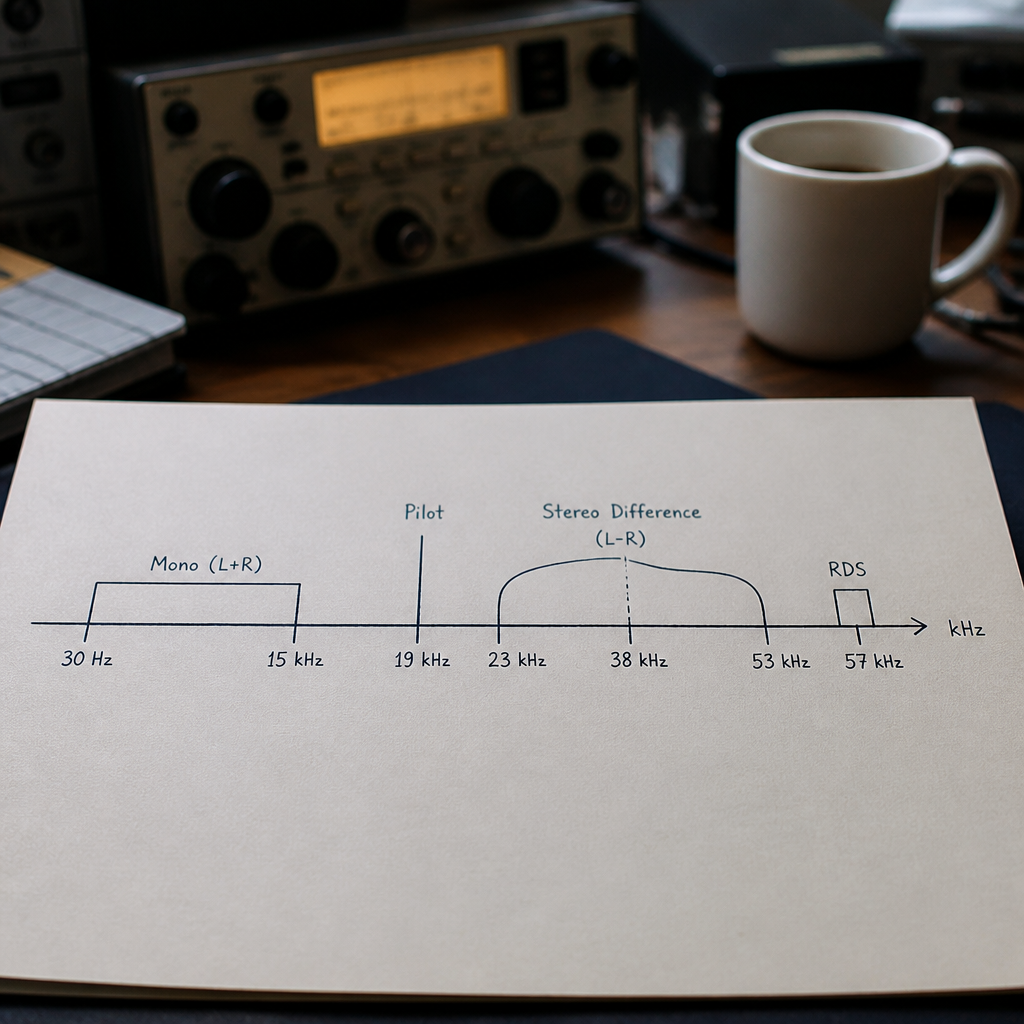
Before anything is modulated onto the carrier, the transmitter builds a single composite audio-frequency signal, usually called the baseband or the multiplex. It is this composite, not the left and right channels, that deviates the carrier. Reading it from the bottom up is the fastest way to understand an FM station.
At the bottom, from about 30 Hz to 15 kHz, sits the sum of the two channels, left plus right. A mono receiver decodes exactly this and nothing else, which is why the stereo system adopted in 1961 could be added without making a single existing radio obsolete.3
Above the audio, at 19 kHz, sits a low-level continuous tone: the pilot. It does two jobs. It tells the receiver that a stereo signal is present, which is what lights the stereo indicator, and it provides a phase and frequency reference. The receiver doubles it to recover a 38 kHz carrier that is locked to the transmitter's own.
Around that 38 kHz point, occupying roughly 23 to 53 kHz, is the difference channel: left minus right, transmitted as a double-sideband suppressed-carrier signal. Suppressing the carrier saves modulation capacity, which is exactly why the pilot has to exist. The receiver reconstitutes the carrier from the pilot, demodulates the difference, and then does the simple arithmetic: sum plus difference gives twice the left channel, sum minus difference gives twice the right.
Higher still, at 57 kHz, which is three times the pilot frequency and therefore easy to keep in step, sits the RDS subcarrier. In North America the applicable standard is RBDS. It is a slow data channel, on the order of a thousand bits per second, and it carries the station name shown on the dashboard, a programme type code, scrolling radiotext, a list of alternative frequencies for the same programme, and flags that let a receiver interrupt for traffic announcements.
Anything above that is a subsidiary communications service. The traditional slots are 67 kHz and 92 kHz, historically used for reading services for blind listeners, background music feeds and, in more recent years, for datacasting and for feeding translators.
| Frequency | What is there | Typical injection | If it disappears |
|---|---|---|---|
| 30 Hz to 15 kHz | Left plus right, the mono sum | Up to 90 % of modulation | Silence on every receiver |
| 19 kHz | Stereo pilot tone | About 9 % | Receivers fall back to mono |
| 23 to 53 kHz | Left minus right, suppressed carrier | Shares the audio budget | Stereo light stays on, image collapses |
| 57 kHz | RDS or RBDS data | About 3 to 5 % | Dashboard text goes blank |
| 67 and 92 kHz | Subsidiary services, data, feeds | Low, licence dependent | Only the subscriber notices |
Pre-emphasis, and the deal FM struck with hiss
FM has an inconvenient property: the noise left after demodulation is not flat. It rises with frequency, so the top of the audio band is where hiss shows up first. The fix, built into the system from the start, is to boost the high frequencies before modulation and cut them by exactly the same curve in the receiver. The wanted signal comes back level and the hiss, which was only ever added in between, is cut along with the boost.
The curve is described by a time constant. North America uses 75 microseconds; most other administrations use 50. In practical terms a 75 microsecond curve begins to lift at a little above 2 kHz and reaches roughly 17 dB of boost by 15 kHz.4
That has a consequence nobody expects until they meet it. A bright, sibilant, cymbal-heavy mix arrives at the modulator already boosted by up to 17 dB at the top, so it hits the 75 kHz deviation ceiling long before a darker mix of the same apparent loudness. Broadcast processing exists in large part to manage this, which is why the subject continues in loudness, and the ceiling nobody can raise.
What the edge of coverage sounds like
Three separate effects shape what a listener hears as a station weakens, and they arrive in a predictable order.
Stereo noise before mono noise
The difference channel sits in the upper, noisier part of the baseband and is recovered with a much worse signal-to-noise ratio than the sum, on the order of 20 dB worse at the same field strength. So hiss appears in stereo well before it appears in mono. Receivers respond by blending progressively towards mono and rolling off the top end as the signal falls. Many listeners never notice the transition, which is the point.
Capture, which is all or nothing
Because an FM receiver limits before it demodulates, it does not mix two signals on the same channel the way an AM receiver does. It locks onto the stronger one and suppresses the weaker almost completely, needing only a few decibels of difference to do it. This is the capture effect, and it is why driving between two co-channel stations produces an abrupt handover rather than a muddle.
Multipath, which is a geometry problem
A signal that arrives by two paths of different length arrives twice, slightly out of step. At some frequencies the copies add, at others they cancel. In a stationary receiver this is a fixed colouration. In a moving car the pattern sweeps across the audio band several times a second and produces the fluttering, buzzing sound broadcasters call picket fencing. It is worst in dense construction and in valleys, and no amount of transmitter power fixes it.
All three are reasons why the boundary drawn on a coverage map is a statistical field strength rather than a promise. That is a subject of its own, taken up in how far a station is allowed to reach.
The digital layer that sits outside all of it
Since the early 2000s many American FM stations have added a digital signal inside their own channel allocation, in the system standardised as NRSC-5 and marketed as HD Radio. It is called in-band on-channel because the digital carriers live on either side of the analogue signal, in the space between roughly 129 and 199 kHz from the centre, under the same emission mask that governs everything else.
In hybrid mode the analogue signal continues untouched, which matters: a receiver that knows nothing about the digital layer hears exactly what it always heard. A receiver that does know will lock to the analogue signal first, then cross-fade to the digital one once it has enough data. To make that cross-fade inaudible, the analogue path is delayed by several seconds, about eight in typical implementations, so that the two versions line up sample for sample.5
The spare digital capacity can be divided. The main channel carries the same programme as the analogue service; the additional subchannels carry separate programming, and a growing share of them exist to feed a translator elsewhere in the market rather than to be listened to directly. Splitting the bitrate has a cost, and a station running three or four subchannels is spending audio quality on each of them.
The digital sidebands were originally authorised at 20 dB below the analogue carrier power. After interference studies, the Commission allowed many stations to run them higher, which improved digital coverage and made the first-adjacent situation more delicate. That trade, more digital reach against more risk to the neighbour, is the same argument the band has been having since 1945, in different units.
Notes
- Wideband FM as a noise-reduction system was demonstrated by Edwin Armstrong in the 1930s. Commercial FM in the United States was first authorised on 42 to 50 MHz in 1941 and moved to 88 to 108 MHz in 1945, which made every receiver sold up to that point useless. Back
- Channel numbering, the 200 kHz spacing and the reserved band at 88.1 to 91.9 MHz are set out in the FCC rules for the FM broadcast service, 47 CFR Part 73 subpart B. Back
- The pilot-tone stereo system was adopted by the FCC in 1961. Its defining virtue was backward compatibility with the mono receivers already in service. North American station data follows the RBDS standard rather than the European RDS specification, though the two share their structure. Back
- Pre-emphasis time constants are 75 microseconds in North America and 50 microseconds in most other administrations. A recording mastered for streaming and pushed straight to air without processing will modulate very differently from one prepared for it. Back
- The diversity delay between the analogue and digital paths is a property of the in-band on-channel system rather than of any particular transmitter, and it is the reason a station's analogue signal is a few seconds behind its own studio clock. Back