Loudness, and the ceiling nobody can raise
Two files can peak at exactly the same number and differ by ten decibels in how loud they sound. The measurement that fixes this is thirty years old, is now written into law in several countries, and points in opposite directions for broadcast and for streaming.
Take a sparse acoustic recording and a densely compressed pop master, and normalise both so that their highest sample sits at exactly the same level. Play them one after the other and one will be obviously, uncomfortably louder. Nothing is wrong with the meter. The meter was answering a different question from the one the ear is asking.
A peak meter reports the largest instantaneous value. Loudness is a matter of energy over time, weighted by the fact that human hearing is not equally sensitive at all frequencies. Those are not the same quantity, and no amount of care with a peak meter will turn one into the other.
What LUFS actually measures
The modern answer is defined in an ITU recommendation, BS.1770, and it is refreshingly simple in outline. The signal is passed through a two-stage filter, known as K-weighting, that approximates the way a head in a sound field emphasises the upper mid range and de-emphasises the very low end. The mean square energy of the filtered signal is then computed, channels are summed with defined weights, and the result is expressed on a logarithmic scale referenced to digital full scale.1
One refinement matters more than all the others: gating. Without it, a programme with long silences measures quieter than the same programme edited tightly, which is absurd. The standard therefore discards blocks below an absolute threshold, then discards blocks more than 10 units below the level of what remains. The measurement describes the parts of the programme that are actually programme.
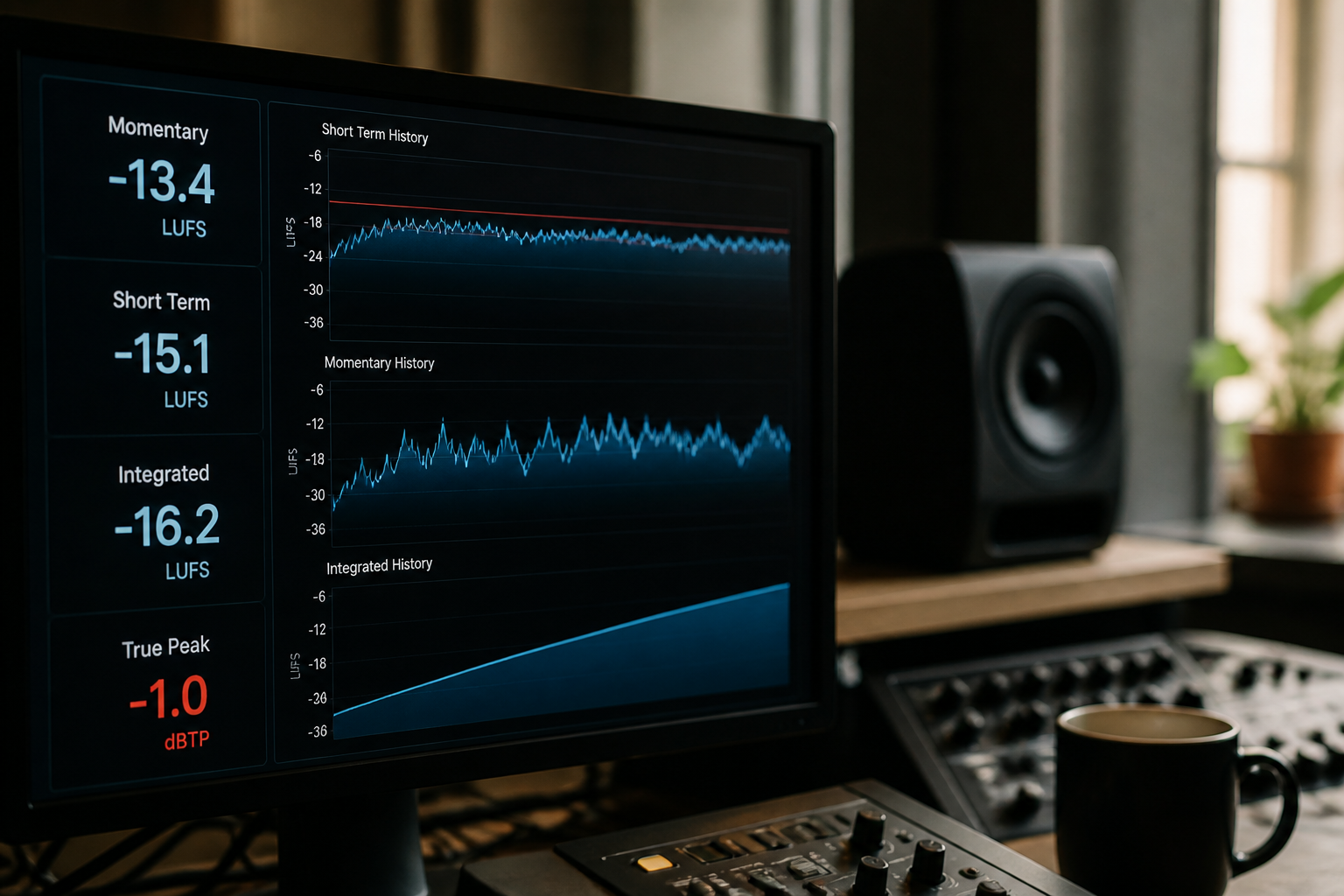
Four numbers come out of a compliant meter, and they answer different questions.
| Reading | Window | Answers |
|---|---|---|
| Momentary | 400 milliseconds | Is this phrase, right now, out of line |
| Short term | 3 seconds | Is this section balanced against the last one |
| Integrated | The whole programme | What number do I deliver against |
| True peak | Instantaneous, oversampled | Will this clip after conversion or encoding |
True peak deserves a sentence of its own. A digital sample meter reads the samples, but the waveform reconstructed between samples can be higher than any of them. Encode that file to a lossy format, or play it through a converter, and the overshoot becomes real distortion. A true peak meter oversamples in order to see it coming, which is why delivery specifications ask for a ceiling of -1 dBTP rather than 0.
Two labels exist for the same quantity. Broadcast documents originating in the ITU and ATSC world write LKFS; European documents write LUFS. They are identical in meaning, and one unit of either equals one decibel.
Loudness normalisation turned the loudness war into an argument nobody can win. Master it louder and the platform simply turns it down, and you keep the damage.
What changed after 2012
Two worlds, ten units apart
The measurement is universal. The target is not, and the gap between the two families of target is the thing that confuses people delivering to both.
Broadcast television settled first, and it settled loudly on legislation. European broadcasters follow EBU R 128, which asks for a programme loudness of -23 LUFS with a tight tolerance and a true peak ceiling of -1 dBTP. In the United States, the equivalent practice document is the ATSC recommendation A/85, and compliance with it became a legal obligation for commercials through the CALM Act, passed in 2010 and enforced from December 2012.2
Streaming platforms arrived later and settled around ten units higher, near -14 LUFS, for the practical reason that most listening happens on phones, in cars and on small speakers where a -23 target would be inaudible. Platform figures are published as guidance and they move, so the number to check is always the current one; the important point is the size of the gap, not the decimal.3
| Destination | Programme loudness | True peak | Set by |
|---|---|---|---|
| European broadcast | -23 LUFS | -1 dBTP | EBU R 128 |
| United States television | Around -24 LKFS | -2 dBTP typical | ATSC A/85, CALM Act |
| Music streaming | Around -14 LUFS | -1 dBTP | Platform guidance |
| Podcast platforms | -16 LUFS stereo | -1 dBTP | Platform guidance |
| FM broadcast | No target exists | Deviation limit | Licence and processor |
That last row is the interesting one, and it is why the next section exists.
What a broadcast processor spends
No FM receiver normalises anything. A station that sounds quieter than the one next to it on the dial is simply quieter, and listeners scanning past will hear it that way. The only limit is the peak deviation described in what is actually riding on an FM carrier, and it is a hard ceiling. The entire incentive is therefore to raise the average level as close as possible to a fixed peak, which is a very different problem from hitting a loudness target.
A broadcast processor does it in stages.
Slow gain control
An automatic gain control with a long time constant absorbs the difference between a quiet album track, a loud one and a presenter's microphone, so that everything downstream sees roughly the same input. It is not supposed to be audible, and when it is, it is set too fast.
Multiband compression
The signal is split into four, five or six frequency bands, each compressed separately, then recombined. This is what makes a station sound consistent from song to song, because it imposes a spectral signature on everything. It is also the source of the characteristic side effect: a very bass-heavy track pushes the low band into gain reduction, the other bands do not follow, and the relative balance of the mix shifts while the bass note lasts.
Final limiting and clipping
The last stage enforces the peak ceiling, and it does so in the pre-emphasised domain, because pre-emphasis has already added up to 17 dB of high frequency boost before the modulator sees the signal. Some of the peak control is done by limiting, which is level dependent, and some by clipping, which is distortion traded for level. How much clipping is acceptable is the oldest argument in the trade.
Everything here is a purchase, and the price is paid in three currencies. Dynamics go first: a heavily processed station has almost no difference between its loudest and quietest moment, which is exactly what makes it survive road noise and exactly what makes it tiring at home. Spectral honesty goes second, because multiband compression is continuously rewriting the balance the mix engineer chose. And on a station carrying a digital signal, the two paths must be processed to match, or the blend between analogue and digital becomes audible as a shift in tone.
Delivering something, in practice
For anyone producing spoken audio rather than running a transmitter, the whole subject reduces to a short procedure.
Measure the integrated loudness of the finished programme, not of individual files, because the target is a property of the whole thing. Set a true peak ceiling of -1 dBTP and let a limiter, not a fader, guarantee it. Then look at the loudness range: a spoken programme with a range of a few units is comfortable in a car and lifeless on headphones, and one with a wide range is the opposite. The listening environment decides, and it is a decision, not a default.4
Two habits are worth unlearning. The first is mastering to the peak meter and hoping, which on a normalising platform simply means the file is turned down and the compression damage is kept. The second is treating a loudness target as a quality standard: hitting -16 LUFS says nothing about whether the recording is intelligible, and intelligibility is decided upstream, in the room and at the microphone, as described in microphones, and the six inches that decide everything.
Notes
- ITU-R BS.1770 defines the loudness algorithm, including K-weighting. Gating was introduced in the second revision of the recommendation and is what makes the measurement usable on programme material with silence in it. Back
- EBU R 128 sets a -23 LUFS programme target and a -1 dBTP ceiling. The ATSC recommended practice A/85 is the American equivalent; the CALM Act of 2010 made compliance with it a legal requirement for television commercials from December 2012. Back
- Streaming and podcast targets are published by each platform as guidance rather than fixed in a standard, and they have been revised more than once. Treat the figures here as the order of magnitude and check the current document before a delivery. Back
- Loudness range, usually written LRA, is defined alongside the EBU measurement set and describes the spread of the short-term loudness over a programme, after the same kind of statistical trimming used in the gated measurement. Back